

Cars are full of all sorts of fluids to help them run. There are less vital fluids, like windshield wiper fluid, and more vital fluids, like brake fluid and engine oil. When you spring a leak, you may ask questions like “What is leaking?” and “What should I do about it?” In this article, we’ll cover some of the most common fluid leaks you may encounter and how to handle them.
Identifying the Leak
Before you can figure out what to do about the leak, you have to identify what is leaking. To start, determine if the leak is coming from your car. This might sound a little silly, but if you park on the street or in a parking lot, there’s a chance the puddle or spot you’ve noticed isn’t actually from your car. You can check under the carriage with a flashlight and look for shiny spots or trails of fluid. If you don’t notice this, and you don’t see any puddles when you park somewhere else, you might not have a leak.
Once you’ve determined that your car is, in fact, leaking, the next step is to figure out what is leaking. Most fluids have a color, texture, or smell that can help you to identify them. If you’re struggling to see the color of the fluid, try leaving a piece of paper or cardboard under the spot with the leak. This can help you to catch some drips and see what color shows up. If the color is too similar to another fluid, check the texture or smell and consider the location of the leak.
Common Car Fluid Colors
Different fluids come in different colors, and it may make it more challenging to identify leaks. Here’s a list of standard colors and which fluids tend to use those colors.
- Light Brown/Amber—Lubricant, New engine oil
- Dark Brown—Brake fluid, Old engine oil
- Red/Reddish-Brown—Power steering fluid, Transmission fluid
- Light Red/Pink—Transmission fluid, Power steering fluid
- Orange—Transmission fluid, Coolant
- Yellow—Coolant
- Green—Antifreeze/Coolant, Windshield wiper fluid
- Blue—Windshield wiper fluid
- Clear—Water, Coolant
Water Leaks
If your vehicle is leaking water, it’s probably nothing to worry about. It’s fairly common for water to leak out of the air conditioner and the exhaust. Both of these are often due to condensation. AC leakage is more common in the summer, and exhaust leakage is more common in the winter. If you notice a lot of water coming from your exhaust and white smoke or steam, it may indicate that you’ve blown your gasket. If that’s the case, you’ll want to have your car serviced.
Windshield Wiper Fluid Leaks
Of all the fluids in your car, windshield wiper fluid is probably the one you can drive without for the longest period of time. Even so, if your wiper fluid reservoir has a leak, it’s still worth repairing. While windshield wiper fluid is not necessarily crucial for making your car run, it can play an important role in keeping you safe by allowing you to see clearly through the windshield. Wiper fluid leaks are often caused by a broken reservoir, and broken reservoirs are often caused by water in your fluid. The water may freeze and expand, cracking the plastic of the reservoir. Depending on the severity of the crack, a mechanic may be able to seal it for you, or they may need to replace it.
Engine Oil Leaks
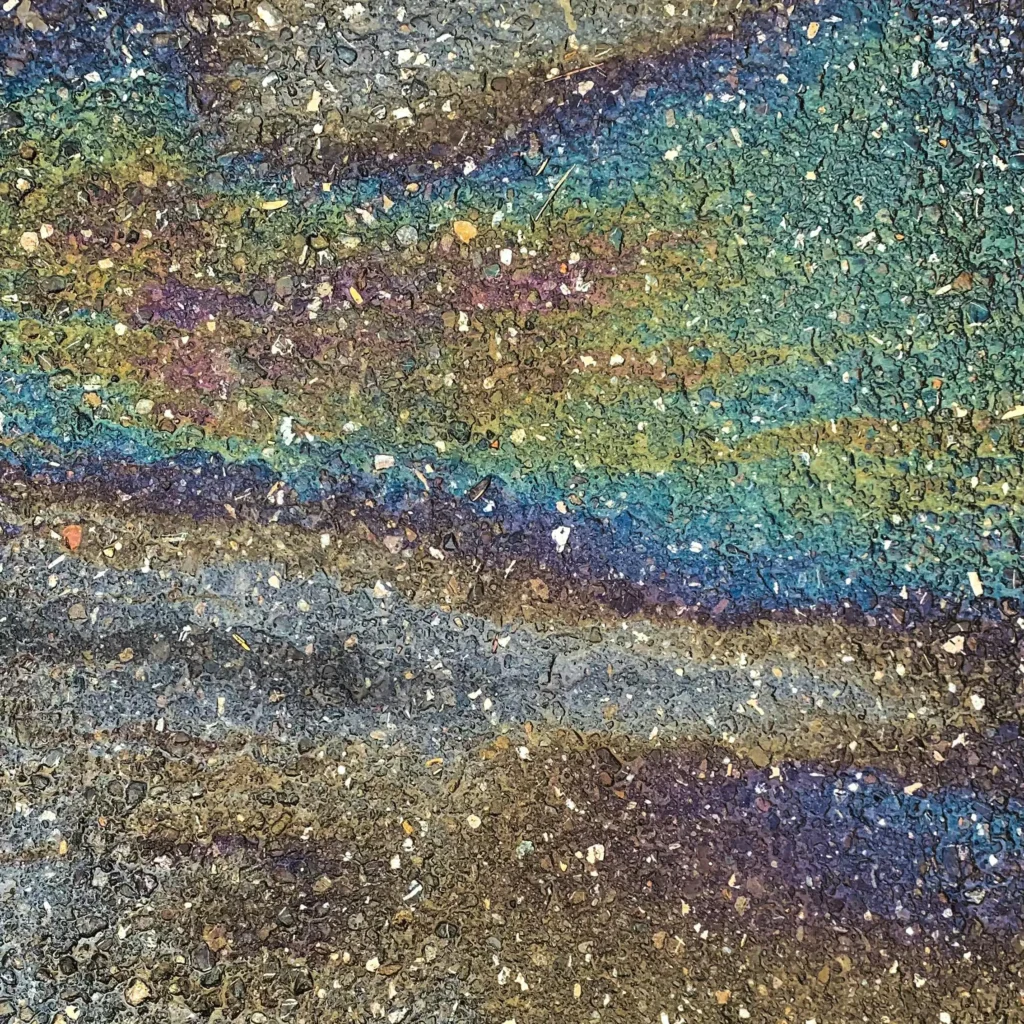
An engine or motor oil leak may be the easiest to spot as oil tends to look multicolored from the right angle. You can also check your oil level by using the dipstick in your engine. Some engine oil leaks may be easier to fix than others. If you aren’t able to fix it yourself and you need to drive it to a mechanic, make sure the oil level is correct before leaving. Driving with low levels of engine oil can cause major damage to your engine.
Coolant Leaks
Coolant is one of the car fluids that can come in multiple colors. Some coolants are green, some are yellow, and some are pink, red, or even clear. Coolant has a distinctly sweet smell, often compared to candy or maple syrup. It also feels almost slimy to the touch. There are a lot of hoses that carry coolant to different parts of the engine, so it can unfortunately leak from almost anywhere. Coolant leaks are most commonly found around the radiator. The coolant helps to keep your engine cool and prevent overheating, so don’t wait to get a coolant leak repaired.
Transmission Fluid Leaks
All car owners know that the transmission is an important (and expensive) part of any car. If you’re leaking transmission fluid, this can be a bigger deal than other types of leaks. It’s better to avoid driving with a leaky transmission as this can lead to further damage. If possible, consider having your car towed to a trusted mechanic. Transmission leaks can be caused by a number of different things including cracks in the fluid lines, broken seals, gasket issues, and normal wear and tear. Don’t delay on having a transmission leak repaired—take it to a mechanic, like the ones at Restored Auto, LLC, as soon as possible.
Fuel Leaks
Like an oil leak, a fuel leak is going to be easier to identify. Gas has a very distinct smell that most, if not all, motorists can identify. A fuel leak is also one of the most dangerous leaks. Even a tiny spark can light fuel and start a fire. If your car is leaking gas, do not drive it. Fuel leaks often occur when the fuel tank is cracked. If it’s a simple crack, a mechanic can probably patch it for you. If there’s rust on your fuel tank, you’ll likely need to replace it. Either way, don’t wait to get a fuel leak repaired. Have your car towed to a trusted mechanic ASAP.
Brake Fluid
The last leak we’ll cover is brake fluid. Brake fluid leaks aren’t very common, but they can be very dangerous. Brake fluid is vital for the function of your brakes. Without it, you may not be able to stop your vehicle. If you’ve noticed a brown fluid leaking under the wheels of your car or around the brakes, it’s probably brake fluid. Do not drive the car. Get it towed to a mechanic, like the ones at Restored Auto, LLC, and have it checked.
Call Restored Auto, LLC to handle your leak.
If you’ve got a leak in your car, it’s important to have it looked at. Some leaks are more dangerous than others, but no leak is a good leak. Call us today to schedule an appointment and have your leak repaired.
Leave a Reply