
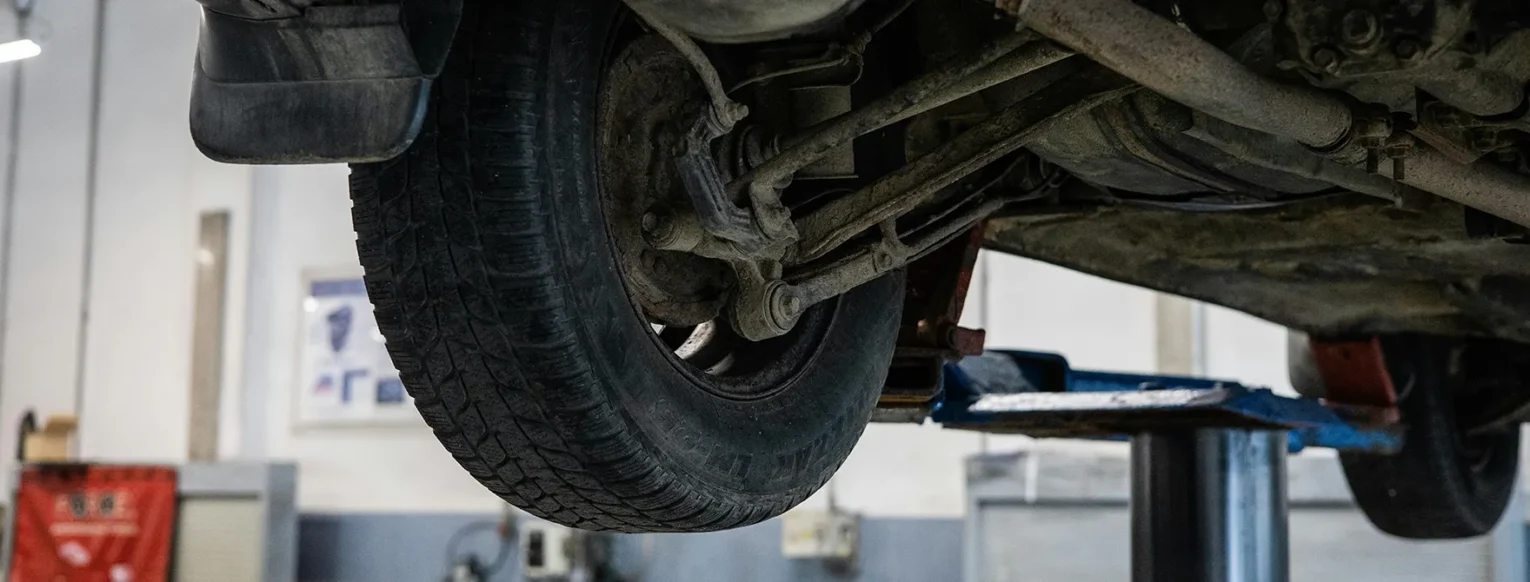
The suspension system is one of the most important systems in any vehicle. It works to absorb impacts from bumps in the road and help with steering and handling. Historically, carriages and wagons were actually suspended on straps of leather attached to the chassis. These straps helped absorb road bumps, and because it was suspended, the name “suspension” stuck. While contemporary vehicles aren’t actually suspended, the suspension system still solves the same problems.
Suspension System Parts
Like most systems in your vehicle, the suspension system is made up of many different parts. Each one plays an important role in the handling and ride of your car. Below we’ll list some of the major parts of a suspension system and what they do.
Springs—The springs of a suspension system help to absorb the wheels’ motion and transfer it to the shock absorbers. There are several different types of springs that can be used in a suspension system. They might be a coil spring, a leaf spring, an air spring, or a torsion bar.
Shock Absorbers—Shock absorbers, also called dampeners, absorb the motion of the spring as your vehicle passes over bumps in the road. You can think of it like an oil pump that sits between your car’s frame and wheels. It converts the energy from the motion of the springs into heat, which is then dissipated through your vehicle’s hydraulic fluid.
Struts—A strut is essentially a shock absorber that’s been mounted directly on a coil. Not every vehicle uses struts. Some vehicles will have shock absorbers on one axel and struts on the other. A strut will dampen movement just like a shock absorber, and it will also aid in the structural support for your suspension.
Sway Bars—A sway bar, sometimes called an anti-roll bar, is a metal bar that joins the sides of a suspension together. Sway bars work with shocks and struts to stabilize vehicles by transferring motion between wheels and lowering the amount of sway a vehicle experiences. Most newer cars come outfitted with sway bars, and there are installation kits available for older cars that don’t have them.
Front Suspension vs. Rear Suspension
Different types of vehicles utilize different types of suspension. Some vehicles use front suspension while others use rear. Some use dependent suspension systems and others use independent. Each type of suspension still works toward the same goal of creating a smoother ride for both passengers and the vehicle itself.
Dependent Front Suspension—A dependent front suspension has a front axle that connects the front wheels together. These are commonly found on trucks, off-road vehicles, and older car models.
Independent Front Suspension—An independent front suspension allows wheels to move independently. There are a few types of independent front wheel suspension systems, including the MacPherson Strut and the double-wishbone suspension. These types of suspension systems are typically found on cars with front wheel drive, sport cars, and SUVs.
Dependent Rear Suspension—Dependent rear suspensions work similarly to dependent front suspensions, only the rear wheels are the ones that are connected. These types of suspensions tend to be much simpler in construction, relying on leaf springs or coil springs. These can be found on off-road vehicles, SUVs, and cars with rear wheel drive.
Independent Rear Suspension—Independent rear suspensions are just like independent front suspensions. Like their dependent counterparts, the main part of the suspension is simply shifted to the rear axle. These can be found on sport cars.
How to Take Care of Your Car’s Suspension
Because the suspension system plays an important role in how safe your car’s handling is, it’s important to maintain it properly. Most parts of your suspension should last for a while. Your shocks and struts may need to be repaired or replaced after 50,000 miles. Because your suspension quite literally takes a lot of bumps, it’s a good idea to check it regularly for signs of damage or wear. Potholes and road hazards have been known to damage suspension.
If you notice your car vibrating, braking or turning erratically, or seeming too bumpy overall, it may be a sign of a suspension issue. Restored Auto, LLC can help. We can help you keep your ride safe and smooth by diagnosing and repairing suspension issues before the damage spreads. Call us today to schedule an appointment.